Lectures by
Charlie Lutes:
- 1. Truth, a Continuous Unfoldment
- 2. The Coming of the New World
- 3. The Search for God
- 4. Responsibility in Life
- 5. A New Heaven and a New Earth
- 6. Karma in Life
- 7. Solving the Mystery of Life
- 8. Pleasure and Pain in Life
- 9. The Development and Use of Our Spiritual Will Power
- 10. The Power of Thought
- 11. Intent and Honesty in Life
- 12. Self Discovery
- 13. The Meaning of Yoga
- 14. The Rebirth of the Senses
- 15. Faith
- 16. Character
- 17. Reincarnation
- 18. The Battlefield Within the Mind
- 19. Destiny of Life
- 20. Love, A True Expression of Life
- 21. Effort and Effects in Life
- 22. Decisions in Life
- 23. Sin
- 24. Spiritual Enlightenment
- 25. Consciousness
- 26. The Absolute
- 27. Truth, Relative and Absolute
- Additional Lectures
- Home
Lectures by
Charlie Lutes
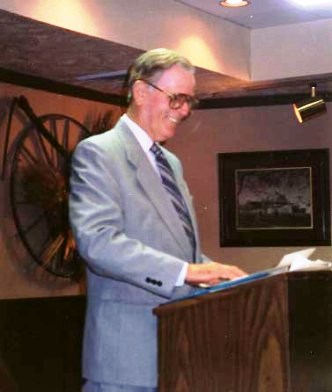
The thrust of all of humanity is to gain liberation, although most of humanity is not aware of this. They are like children in school caught up in play who have not yet learned that the purpose of going to school is to be educated. Most people in the world are totally unaware of the real purpose of life, or even if there is a purpose. It is only when they reach a higher state of consciousness that they become aware of the real purpose of life. It is then that they become earnest seekers and strive to reach liberation. At this point their life takes on real meaning and they start their spiritual journey.
It was Plotinus who long ago said that the spiritual journey is “a flight of the alone to the alone.” There is one thing in life that has no second and that is the Absolute; which is reality, truth or God. That which cannot be compared with anything else, that which has no second, must be the alone or the Absolute. It is the Absolute that stands alone and it is the relative that can be compared and contrasted to everything. The Absolute is not opposite to the relative. Therefore, it cannot be compared with the relative. It is the relative that is a mental projection of the Absolute.
The term “aloneness” worries many because aloneness seems to imply an end result of loneliness. But, nothing is farther from the truth. Loneliness is an external condition, whereas aloneness is an inner state of Being. Most people are afraid of loneliness because they come face to face with the pressure of their own mind, or thoughts, and this they cannot cope with. However, one can be alone in the company of many people because aloneness is an inner state where one is completely free from the company of the thinker and the thought.
It is actually the absence of the observed that makes one feel lonely. The world of the observed is the only thing that one has known and when that becomes disturbed the feeling of loneliness appears.
However, it is in times of loneliness that one discovers the joy of aloneness. Now escape, or refusal to repair the broken image, no longer exists since one has now discovered the inward path to freedom.
The Absolute is pure consciousness, unexpressed pure potentiality; restful alertness. To understand the Absolute one must transcend the field of the relative. Through the practice of Transcendental Meditation one transcends the field of the relative and in so doing the mind becomes infused with the nature of the Absolute, or pure consciousness. This is when the mutation of the mind takes place; an expansion of consciousness takes place. There is no condition of the thinker and the thought.
This experience most certainly is never the result of conscious attitudes of the mind; rather it is when all attitudes have vanished. It is through Transcendental Meditation that one is laying the foundation of eternal freedom, and through the experience of the mutation of the mind, becomes a member of that stream of society that is rapidly evolving to the goal of human life. One is now in the process of leaving the field of constant change and entering the Absolute field of no change, the field that is eternally permanent where the past and the future have merged into the now, where eternity is not an endless sequence of time frames, but where time no longer exists and eternity is the now. Also, where all live in eternal youth and everything is self-luminous. This is the Absolute.
"It is through Transcendental Meditation that one is laying the foundation of eternal freedom, and through the experience of the mutation of the mind, becomes a member of that stream of society that is rapidly evolving to the goal of human life."
© 2005-2011 by Vincent J. Daczynski. All Rights Reserved.